
Economics of Being a Writer
A fellow author I respect recently shared some insights on the economics of being a writer. The results were not as detailed as I like, so I opted to have Claude do deep diving. After reviewing 471 sources, it came back with some interesting findings.
The results are in, and the metaphor has shifted. We used to say "a rising tide lifts all boats." From 2014 to 2017, that was true. Today? The rising tide only lifts the yachts.
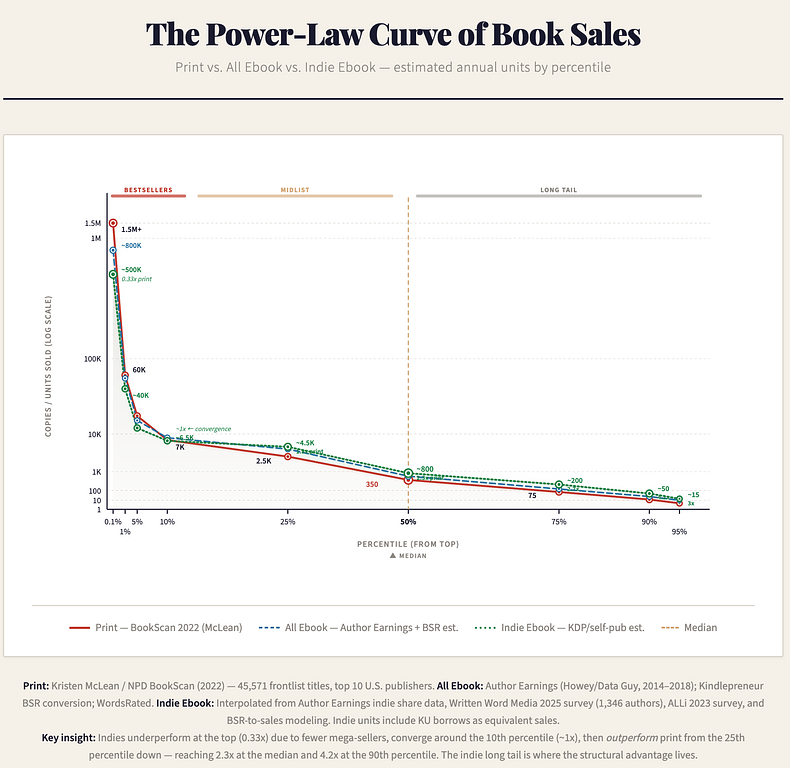
Success has always been dictated by visibility. However, visibility has become a "pay to play" game with ad costs rising beyond the new author's budget. The advantage goes to those with a deep backlist.
If you factor out the hobbyists, as the graph above does, the median author makes about $13,000/year. But the median author doesn't have dozens of books out. Nor do they have several series. They goalposts moved from 20 books to a sustainable career to 30. If you write four books a year, you're looking at a decade long build. The message? Write faster.
The one finding that worries authors is that AI is flooding certain genres like paranormal romance. It's pushing down organic visibility. But AI can’t easily replicate a unique author voice, a dedicated newsletter community, or "human-only" bonus content. It's been said before, AI can't top humans in originality and "crazy." (Thanks to Joe Solari for that insight.)
The "write faster" doesn't mean "write with AI." We crave connection, and you can't connect with AI. That's why I limit AI.
How do I use AI?
To augment research I've already done. I read a dozen books for the Strand series, and specifically a biography on King George III for the third in the series. I have started some light reading Armaments and the Coming of War for a series I'm contemplating.

But once I've digested my research and committed to writing, I don't want to stop to do detailed research on every topic. When I did that in the past, I found myself in a rabbit warren and lost precious time. Now I can have AI read my notes or do supplemental web research while I stay in creative mode.
In Strand: Discovery, I repatriated a Native American to another tribe in the middle of the book, but returned him to his original tribe in time for the big finale. My beta readers missed it. With Amazon now allowing readers to use AI to ask questions about books, these continuity errors are ticking time bombs. So I use Notebook LLM to cut the red wire.
Even "pro" cover artists heavily supplement with AI assets. The last cover I bought was mostly AI content. So I've reclaimed control over my cover art. I even wrote a tool to manage text elements and hierarchy better across a series.